







Introduction
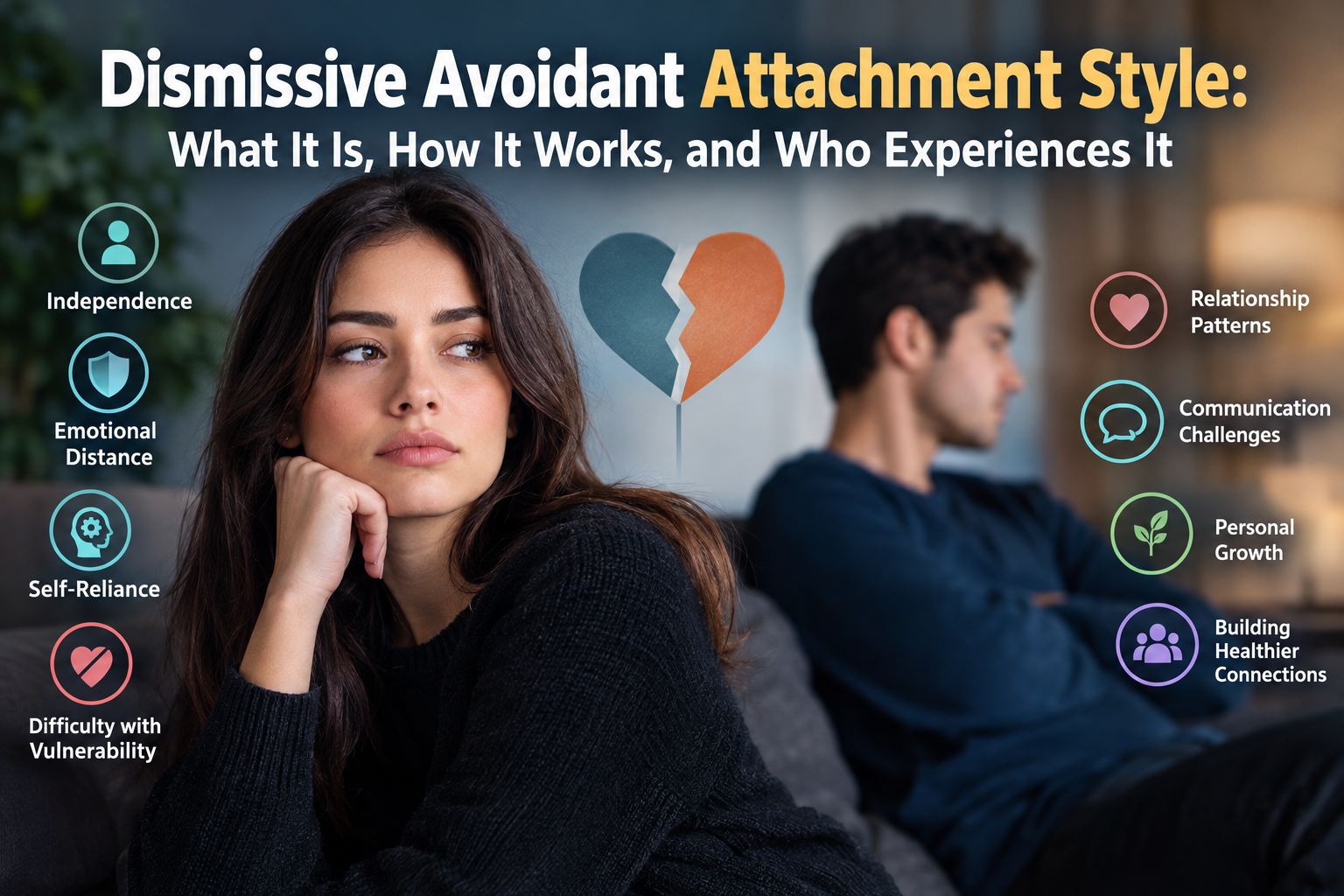
The dismissive avoidant attachment style is a pattern of relating to other people that is often associated with emotional independence, discomfort with vulnerability, and a tendency to keep relationships at a certain distance. People with this attachment pattern may appear confident, self-sufficient, or emotionally strong, but they can sometimes find it difficult to depend on others or allow others to depend on them. Understanding this style can provide useful insight into relationship behavior, communication, emotional boundaries, and personal growth. Attachment styles are not fixed labels that completely define a person. Instead, they describe patterns that may develop through early experiences and continue to influence how someone approaches closeness and emotional connection. A person with dismissive avoidant tendencies may value freedom and personal space while feeling uncomfortable when a relationship becomes highly emotionally intense. Learning about dismissive avoidant attachment style can therefore help people recognize patterns without judging themselves or others.
What Is Dismissive Avoidant Attachment Style?
The dismissive avoidant attachment style is commonly described as an attachment pattern in which a person places a strong emphasis on independence and may minimize the importance of emotional closeness. Such individuals may prefer solving problems on their own rather than asking for support, and they can feel uncomfortable when another person expects a high degree of emotional availability. This does not necessarily mean that they do not care about people. In many cases, they may have deep feelings but have learned to manage those feelings privately. Emotional dependence may feel unfamiliar, unnecessary, or even uncomfortable. As a result, they might create distance when they feel that someone is becoming too close. The term is used within attachment theory, but it should not be treated as a clinical diagnosis. People can display some avoidant characteristics without fitting neatly into one attachment category.
Who Is a Dismissive Avoidant Person?
A person described as having dismissive avoidant tendencies is someone who may strongly value autonomy, personal freedom, and emotional self-reliance. They may be comfortable spending time alone and may not naturally seek reassurance from friends or romantic partners. In relationships, they can sometimes appear reserved because they prefer to process emotions internally instead of discussing them immediately. However, it is important not to assume that every independent or quiet person has an avoidant attachment style. Independence can simply be a personality preference. Attachment patterns become more meaningful when they consistently influence how a person responds to emotional intimacy, conflict, trust, dependence, and vulnerability. Someone with dismissive avoidant tendencies may also have successful and caring relationships while still needing more personal space than some partners expect.
Common Signs of Dismissive Avoidant Attachment Style
There are several behaviors that may be associated with this attachment pattern. One common sign is a strong preference for independence. A person may feel more comfortable handling difficult situations alone rather than asking another person for assistance. Another possible sign is discomfort with emotional conversations, particularly when the discussion involves vulnerability, commitment, or intense feelings. Some people may change the subject, become quiet, withdraw, or focus on practical solutions instead of emotional reassurance. They may also value personal space and become uncomfortable when they feel pressured to spend more time together. In romantic relationships, they might have difficulty expressing affection verbally or discussing their deeper emotional needs. Another characteristic can be emotional distancing, especially during conflict. It is important to remember that these behaviors can have many explanations, including personality, culture, past relationships, stress, or communication habits, so they should not automatically be interpreted as proof of an attachment style.
How Does Dismissive Avoidant Attachment Develop?
Attachment patterns are influenced by a combination of early relationships, experiences, temperament, and later life events. In some cases, dismissive avoidant tendencies may develop when a child learns that emotional needs are not consistently welcomed or responded to. If expressing sadness, fear, or a desire for comfort repeatedly leads to rejection, criticism, or emotional unavailability, the child may gradually learn to rely more heavily on themselves. Over time, independence can become a protective strategy. However, childhood experiences are not the only factor. Adult relationships, difficult breakups, betrayal, family dynamics, social expectations, and personal experiences can also influence how someone approaches intimacy. Attachment patterns can change throughout life, which means a person’s current behavior does not have to remain permanent.
Dismissive Avoidant Attachment in Romantic Relationships
Romantic relationships can make this attachment pattern particularly noticeable because intimacy naturally involves vulnerability and emotional dependence. A person with dismissive avoidant tendencies may initially enjoy a relationship because it provides companionship without requiring immediate emotional exposure. As intimacy increases, however, they may begin to feel uncomfortable or overwhelmed. They might request more space, spend more time alone, or become less communicative. In some situations, a partner may interpret this behavior as a lack of love or interest, while the avoidant person may simply be trying to regain a sense of emotional control. This difference in interpretation can create misunderstandings. Healthy communication becomes especially important because both people need to understand each other’s needs rather than assuming what the other person’s behavior means.
Communication Patterns and Emotional Expression
Communication can be challenging when one person prefers emotional distance and another wants frequent reassurance. Someone with dismissive avoidant characteristics may communicate effectively about practical matters while struggling to discuss feelings. They might say that everything is fine even when they are stressed or upset because acknowledging emotional needs can feel uncomfortable. During disagreements, they may prefer taking time alone instead of continuing a heated conversation. This need for space is not automatically unhealthy. The important factor is how that space is communicated and whether the person eventually returns to the conversation. Healthy boundaries involve explaining the need for time rather than disappearing or intentionally using silence to punish another person. Developing the ability to communicate emotions gradually can help make relationships more stable.
Dismissive Avoidant Attachment and Intimacy
Intimacy involves allowing another person to understand parts of yourself that are normally kept private. For someone with a dismissive avoidant pattern, this level of openness can feel unfamiliar. They may prefer showing care through actions rather than emotional conversations. They might help solve a problem, provide practical assistance, or spend quiet time with someone instead of openly discussing their feelings. This can sometimes lead to a mismatch between what they feel and what they communicate. A partner may need verbal reassurance, while the avoidant individual may assume that their actions already demonstrate their feelings. Recognizing these different forms of communication can reduce misunderstandings. Emotional intimacy does not require losing independence; it involves learning that closeness and autonomy can exist together.
Dismissive Avoidant Attachment and Conflict
Conflict often reveals attachment patterns because disagreements can activate strong emotional reactions. A dismissive avoidant person may respond to conflict by withdrawing, becoming less expressive, or focusing heavily on logic. They may need time to calm down before they can discuss the issue productively. This can become problematic if withdrawal turns into prolonged avoidance. Healthy conflict resolution requires both people to have enough space to regulate emotions while also maintaining a commitment to addressing the problem. A useful approach is to communicate clearly: explain that a break is needed, identify when the conversation can continue, and return to the issue afterward. This approach preserves personal space without allowing difficult conversations to disappear completely.
Can Dismissive Avoidant Attachment Style Change?
Yes, attachment patterns can change. They are not permanent personality labels. People can develop greater emotional awareness and learn new ways of responding to closeness, conflict, and vulnerability. Change usually begins with recognizing existing patterns without excessive self-criticism. A person might notice that they regularly withdraw whenever a partner expresses strong emotions or that asking for help feels unusually difficult. Recognizing these reactions creates an opportunity to experiment with healthier responses. Self-awareness, communication skills, supportive relationships, and professional guidance when appropriate can all contribute to personal growth. Change does not mean becoming dependent on other people. Instead, it can mean becoming comfortable with both independence and meaningful connection.
How to Build Healthier Relationships
Someone with dismissive avoidant tendencies can work toward healthier relationships by practicing small forms of emotional openness. Rather than attempting to share everything immediately, they can begin by communicating simple feelings and needs. Saying, “I need some time to think, but I want to discuss this later,” can be more constructive than completely withdrawing. Another useful step is learning to recognize emotional triggers. If closeness creates an urge to escape, taking a moment to understand that reaction can prevent automatic decisions. Partners can also contribute by respecting boundaries while communicating their own needs clearly. The goal is not to eliminate independence but to create a relationship where trust, boundaries, communication, and emotional connection can coexist.
Misconceptions About Dismissive Avoidant People
One common misconception is that people with dismissive avoidant characteristics do not have emotions or do not care about relationships. This is an oversimplification. Attachment style primarily concerns patterns of relating and responding to intimacy; it does not determine the depth of someone’s feelings. Another misconception is that every person who enjoys being alone is avoidant. Many emotionally secure people enjoy solitude and independence. Similarly, needing personal space during a disagreement does not automatically indicate an attachment issue. Context matters. Attachment concepts are most useful when they help explain repeated patterns rather than becoming labels used to judge someone’s character.
The Difference Between Independence and Avoidance
Independence and avoidance may look similar from the outside, but they are not necessarily the same. An independent person can enjoy personal space while still feeling comfortable with emotional intimacy, asking for help, and relying on others when necessary. Avoidant patterns may involve a stronger tendency to minimize emotional needs or create distance when closeness feels uncomfortable. The distinction often depends on flexibility. A healthy independent person can move between autonomy and connection according to the situation. Someone struggling with avoidant patterns may find that moving toward intimacy consistently produces discomfort or an urge to withdraw. Understanding this difference can prevent people from incorrectly labeling normal independence as an attachment problem.
Frequently Asked Questions
1. What is dismissive avoidant attachment style?
Dismissive avoidant attachment style is an attachment pattern commonly associated with strong self-reliance, discomfort with emotional vulnerability, and a preference for personal independence. It is not a clinical diagnosis and does not completely define someone’s personality or relationships.
2. Do dismissive avoidant people have feelings?
Yes. People with dismissive avoidant tendencies can experience strong emotions and care deeply about others. The difference may be in how they process or express those emotions. Some may be more comfortable handling feelings privately than discussing them openly.
3. Can a dismissive avoidant person have a healthy relationship?
Yes. Attachment patterns can change, and people with avoidant tendencies can develop healthy relationships. Communication, boundaries, emotional awareness, trust, and willingness to address problems can help create stronger connections.
4. Why does a dismissive avoidant person need so much space?
Personal space may help them feel independent and emotionally comfortable. When closeness becomes intense, they may experience an increased desire for distance. However, individual reasons vary, so it is better to discuss needs directly rather than assume what someone is feeling.
5. Can dismissive avoidant attachment style change?
Yes. Attachment patterns are capable of changing through new experiences, self-awareness, healthier relationships, improved communication, and sometimes professional support. Change generally involves learning to balance independence with emotional connection rather than giving up independence altogether.
Conclusion
The dismissive avoidant attachment style describes a pattern in which independence and emotional self-reliance may take priority over closeness and vulnerability. People who display these tendencies are not necessarily uncaring, unemotional, or incapable of maintaining meaningful relationships. Their behavior may reflect learned strategies for managing intimacy and emotional needs. Understanding the difference between healthy independence and emotional avoidance is important because attachment labels should be used as tools for understanding rather than judgments about someone’s character. With self-awareness, honest communication, healthy boundaries, and supportive relationships, people can develop more flexible ways of connecting with others. Ultimately, understanding attachment style is less about putting someone into a fixed category and more about recognizing patterns that can be understood, communicated about, and changed over time.