








Introduction to 120 Volts to Watts
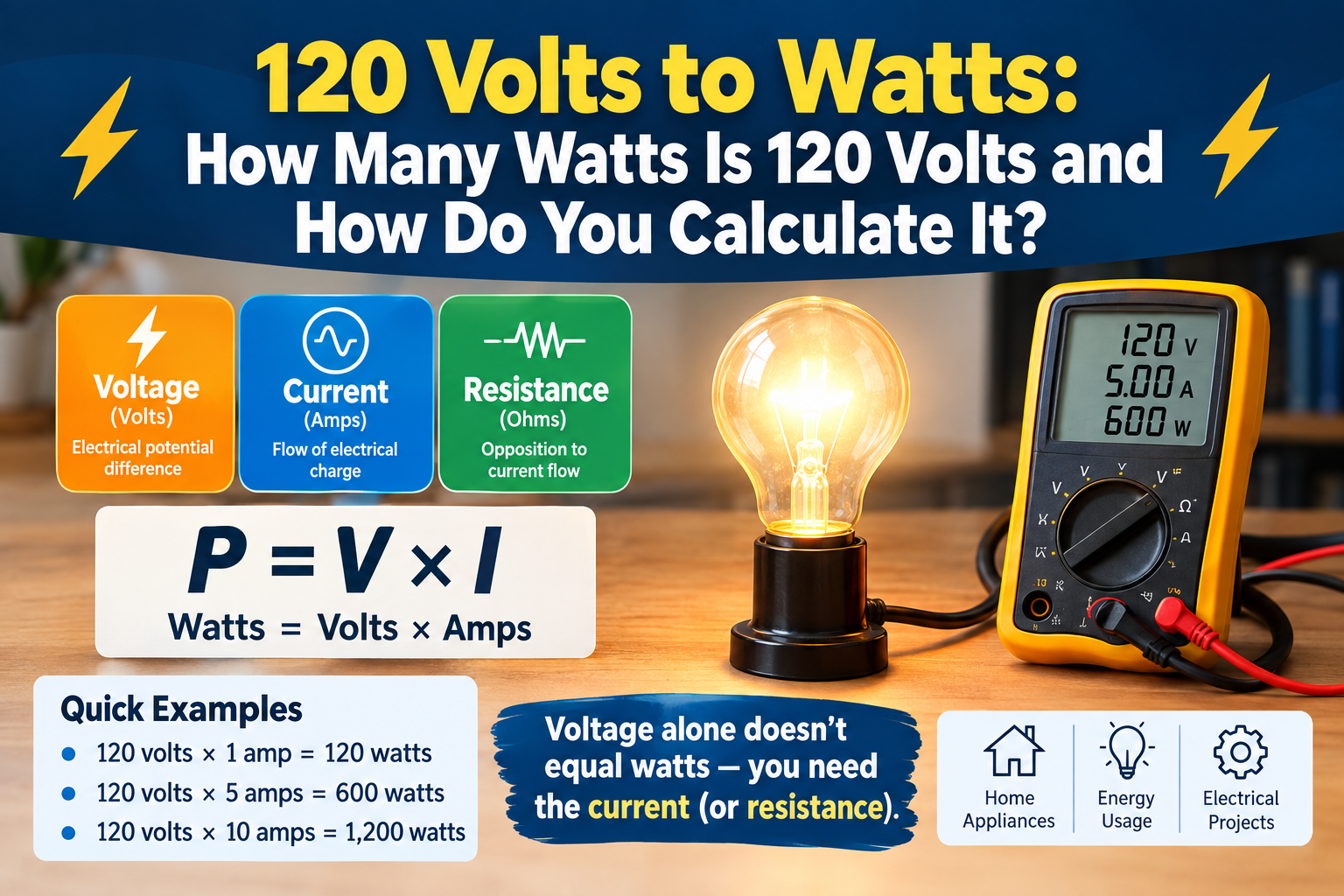
The term 120 volts to watts is commonly used by people who want to know how much electrical power a device uses when it operates at 120 volts. However, volts and watts are two different electrical measurements, so 120 volts does not automatically equal a fixed number of watts. To calculate watts, you generally need to know the amount of current in amps that the electrical device draws. The basic formula is Watts = Volts × Amps. This means that a 120-volt device drawing 1 amp uses 120 watts, while a device drawing 5 amps uses 600 watts. Understanding this relationship is useful when reading appliance labels, estimating electrical loads, learning basic electricity, or comparing the power requirements of different devices.
What Does 120 Volts Mean?
Voltage represents electrical potential difference. It can be understood as the force or pressure that encourages electrical current to move through a circuit. When an appliance is labeled for 120 volts, it means the appliance is designed to operate at that particular voltage under its specified conditions.
However, the voltage rating does not tell you the exact power consumption by itself. Two appliances can both operate at 120 volts while consuming completely different amounts of power. A small lamp might use 60 watts, while a larger heating appliance could use more than 1,000 watts. Both can operate from a 120-volt supply because they draw different amounts of current.
This is why the question of 120 volts to watts requires another piece of information. In most basic calculations, that additional information is the current measured in amps.
How to Calculate 120 Volts to Watts
The simplest formula for calculating electrical power is:
Watts = Volts × Amps
When the voltage is 120 volts, the formula becomes:
Watts = 120 × Amps
For example, if an appliance operates at 120 volts and draws 2 amps, the calculation is:
120 × 2 = 240 watts
Therefore, the appliance uses approximately 240 watts under those conditions.
If another appliance draws 5 amps at 120 volts:
120 × 5 = 600 watts
The calculated power is therefore 600 watts.
A device drawing 10 amps at 120 volts would have a calculated power of:
120 × 10 = 1,200 watts
These examples show why 120 volts cannot be converted to one fixed wattage without knowing the current.
120 Volts to Watts Conversion Chart
The following chart provides some common examples:
| Current | Voltage | Power |
|---|---|---|
| 0.5 amp | 120 V | 60 W |
| 1 amp | 120 V | 120 W |
| 2 amps | 120 V | 240 W |
| 3 amps | 120 V | 360 W |
| 5 amps | 120 V | 600 W |
| 8 amps | 120 V | 960 W |
| 10 amps | 120 V | 1,200 W |
| 12 amps | 120 V | 1,440 W |
| 15 amps | 120 V | 1,800 W |
| 20 amps | 120 V | 2,400 W |
The chart demonstrates an important principle: when voltage stays at 120 volts, the wattage increases as the current increases. For example, doubling the current from 5 amps to 10 amps doubles the calculated power from 600 watts to 1,200 watts.
Can You Calculate Watts From 120 Volts Without Amps?
Voltage alone is normally not enough to determine the wattage of a device. You need either the current, the resistance, or additional information about the electrical load.
When current is known, use:
P = V × I
When resistance is known, the power formula can be written as:
P = V² ÷ R
For example, suppose a resistive load operates at 120 volts and has a resistance of 60 ohms. The calculation would be:
P = 120² ÷ 60
P = 14,400 ÷ 60
P = 240 watts
This demonstrates that resistance can also be used to determine power when voltage is known.
Examples of 120 Volts to Watts
Let’s look at several simple examples to make the calculation easier to understand.
Suppose a small electronic device operates at 120 volts and draws 0.5 amps. Using the formula:
120 × 0.5 = 60 watts
The device therefore has a calculated power of 60 watts.
Now consider a device drawing 3 amps:
120 × 3 = 360 watts
Its calculated power is 360 watts.
For a device drawing 8 amps:
120 × 8 = 960 watts
The power is 960 watts.
For a larger 12-amp load:
120 × 12 = 1,440 watts
Therefore, the calculated power is 1,440 watts.
These examples make it clear that the same 120-volt supply can be associated with many different wattage values depending on the current drawn by the device.
Understanding 120 Volts, Amps, and Resistance
Three important electrical concepts are voltage, current, and resistance. Voltage is measured in volts, current is measured in amperes or amps, and resistance is measured in ohms.
These quantities are connected by Ohm’s Law:
V = I × R
From this relationship, current can be calculated as:
I = V ÷ R
Once the current is known, power can be calculated with:
P = V × I
For example, imagine a 120-volt electrical load with a resistance of 30 ohms. First, calculate the current:
120 ÷ 30 = 4 amps
Then calculate the power:
120 × 4 = 480 watts
So the load has a calculated power of 480 watts.
This approach is particularly useful when working with basic electrical circuits where resistance is known.
120 Volts to Watts for AC Devices
Many household electrical devices operate using alternating current, commonly known as AC. For simple resistive loads, the basic voltage-and-current relationship can be used to determine real power.
However, some AC equipment contains motors, transformers, or electronic components. These devices can have a power factor, which affects the relationship between voltage, current, and real power.
For a single-phase AC load, real power can be calculated using:
P = V × I × Power Factor
For example, suppose an AC device operates at 120 volts, draws 5 amps, and has a power factor of 0.8:
120 × 5 × 0.8 = 480 watts
In this situation, simply multiplying voltage by current gives 600 volt-amperes, while the real power is 480 watts because of the power factor.
For everyday calculations, the information printed on the device’s rating label is often the most useful source for determining its actual power requirements.
Why 120 Volts Does Not Equal a Fixed Number of Watts
One of the most common misunderstandings about electricity is thinking that volts can be directly converted into watts without any additional information. Volts and watts measure different things.
Voltage describes electrical potential difference, while watts describe the rate at which electrical power is being used or delivered.
Imagine two appliances connected to the same 120-volt supply. One appliance draws 1 amp, while another draws 10 amps. The first has a calculated power of 120 watts, while the second has a calculated power of 1,200 watts.
The voltage is identical, but the wattage is completely different because the current is different.
Therefore, if someone asks, “How many watts are in 120 volts?” the answer depends on the current. At 1 amp, it is 120 watts. At 5 amps, it is 600 watts. At 10 amps, it is 1,200 watts.
Common Applications of 120-Volt Calculations
Understanding 120 volts to watts can be useful in many practical situations. Homeowners may want to understand the power ratings of household appliances, while students may need the formula for electrical assignments. Technicians and electronics enthusiasts may also use these calculations when analyzing circuits.
For example, knowing the wattage of an appliance can help you understand how much electrical power it requires while operating. A small charger may consume only a few watts, while a heater can require hundreds or thousands of watts.
The calculation can also help explain why different devices have different current ratings even when they are designed to operate at the same voltage.
Electrical calculations should always be combined with the manufacturer’s specifications and appropriate safety practices. High-current electrical circuits can present serious hazards, and professional assistance may be necessary for electrical installation or repair work.
Difference Between Watts and Watt-Hours
Another important concept is the difference between watts and watt-hours.
Watts measure power, while watt-hours measure energy used over a period of time.
For example, imagine a device that continuously uses 600 watts for two hours. Its energy consumption would be:
600 watts × 2 hours = 1,200 watt-hours
This is equal to:
1.2 kilowatt-hours
The distinction is important because a device can have a high wattage but operate for a short period, or have a lower wattage and operate continuously for many hours.
Therefore, wattage tells you the rate of power use, while watt-hours tell you how much energy has been consumed over time.
How to Find Watts From a Device Label
Many electrical appliances have a rating label containing information such as voltage, amperage, watts, or frequency. If a device label gives both voltage and current, calculating watts is straightforward.
For example, if a label states:
120 V, 4 A
You can calculate:
120 × 4 = 480 watts
If the label directly provides a wattage rating, you generally do not need to calculate it yourself.
When dealing with motors or other complex AC equipment, the label may provide additional information such as power factor or horsepower. In those situations, the basic formula may not provide the complete picture of actual power consumption.
Frequently Asked Questions
1. How many watts is 120 volts?
There is no single wattage for 120 volts. You need the current to calculate power. The formula is Watts = Volts × Amps. Therefore, 120 volts at 1 amp equals 120 watts, while 120 volts at 5 amps equals 600 watts.
2. What is the formula for converting 120 volts to watts?
The basic formula is Watts = Volts × Amps. For a 120-volt electrical system, multiply 120 by the number of amps. For example, 120 volts × 10 amps equals 1,200 watts.
3. How many watts are 120 volts at 10 amps?
At 120 volts and 10 amps, the calculated power is 1,200 watts. The calculation is 120 × 10 = 1,200 watts.
4. Can I calculate watts from 120 volts and resistance?
Yes. For an appropriate resistive load, you can use the formula P = V² ÷ R. For example, 120 volts across a 60-ohm resistance results in 240 watts.
5. Is 120 volts the same as 120 watts?
No. 120 volts is not the same as 120 watts. Volts measure electrical potential difference, while watts measure power. A 120-volt device can consume many different amounts of power depending on its current and electrical characteristics.
Conclusion
Understanding 120 volts to watts becomes much easier once you understand the relationship between voltage, current, and power. The most important formula is P = V × I, which means that watts are calculated by multiplying volts by amps.
At 120 volts and 1 amp, the calculated power is 120 watts. At 120 volts and 5 amps, it is 600 watts, while 120 volts at 10 amps produces a calculated power of 1,200 watts. These examples show why there is no universal answer to the question of how many watts 120 volts represents.
When resistance is known, the formula P = V² ÷ R can also be useful for suitable resistive loads. For AC equipment, factors such as power factor may need to be considered when determining actual real power.
The main point to remember is that 120 volts does not automatically equal a specific number of watts. The wattage depends on the current, resistance, and, for some AC equipment, other electrical characteristics. By understanding these basic relationships, you can more confidently interpret electrical ratings and perform simple power calculations.