







Introduction
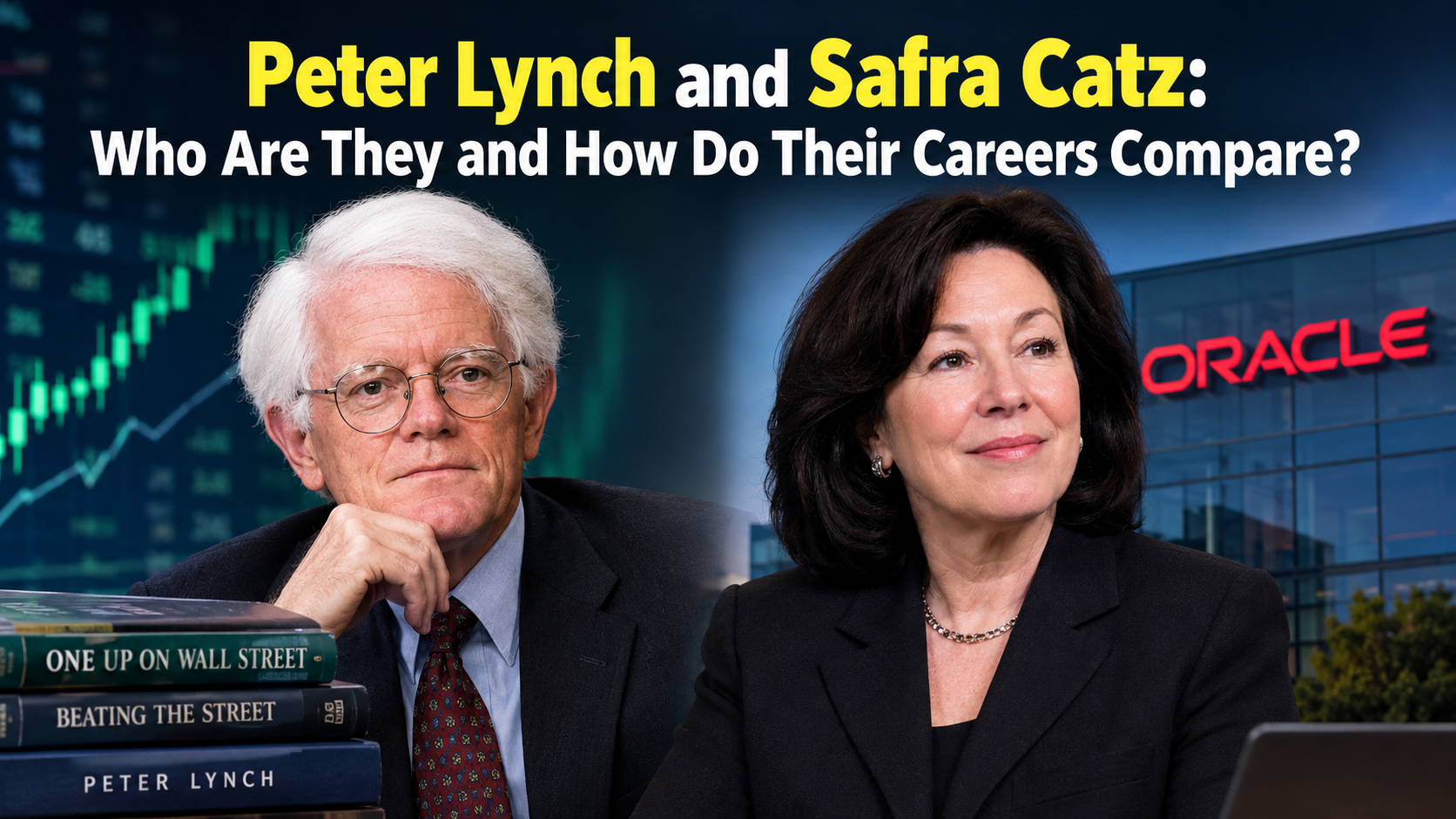
Peter Lynch and Safra Catz are two highly recognized names in the worlds of finance, investment, and corporate leadership, although they built their reputations in very different ways. Peter Lynch became famous as one of the most successful mutual fund managers in modern financial history, while Safra Catz established herself as a powerful technology executive through her long career at Oracle. Their professional paths demonstrate two distinct approaches to achieving extraordinary results: Lynch became known for identifying promising companies and investing with a long-term perspective, while Catz became known for financial discipline, strategic decision-making, mergers and acquisitions, and corporate management.
Peter Lynch managed Fidelity’s Magellan Fund from 1977 to 1990 and became widely respected for his ability to identify businesses with strong growth potential. During his tenure, Magellan’s assets grew dramatically, helping establish Lynch as a legendary figure among individual and professional investors. Safra Catz, meanwhile, joined Oracle in 1999 after working in investment banking and eventually became one of the company’s most influential executives. Oracle identifies her current role as executive vice chair of the board, following her earlier positions as president, chief financial officer, and CEO.
Although there is no obvious professional partnership between Peter Lynch and Safra Catz, comparing their careers is interesting because both have demonstrated how financial knowledge can shape major decisions. One influenced the investment world by managing capital and selecting companies, while the other influenced the technology industry by helping manage and expand one of its largest corporations.
Who Is Peter Lynch?
Peter Lynch is an American investor, author, philanthropist, and former mutual fund manager best known for his extraordinary career at Fidelity Investments. He joined Fidelity in the 1960s and eventually became the manager of the Magellan Fund in 1977. His thirteen-year period managing the fund became the defining chapter of his career.
Lynch developed a reputation for studying companies carefully and looking for businesses whose future prospects were not fully reflected in their stock prices. Rather than relying exclusively on complicated financial theories, he often emphasized understanding the businesses behind stocks. This approach made his investment philosophy particularly accessible to ordinary investors.
One of Lynch’s most famous ideas was that investors could discover useful investment opportunities by paying attention to companies and products they encountered in everyday life. However, his approach was much more sophisticated than simply buying familiar brands. He emphasized research, financial analysis, understanding a company’s competitive position, and knowing why an investment was attractive.
During his time managing Magellan, the fund became one of the world’s best-known investment funds. His performance and ability to communicate investment concepts helped turn him into a household name among people interested in the stock market.
Peter Lynch’s Investment Philosophy
The investment philosophy associated with Peter Lynch centers on patience, research, and understanding businesses. He was not known for believing that investors could predict every movement in the stock market. Instead, he emphasized finding strong companies and allowing successful investments enough time to produce meaningful returns.
Lynch also recognized that mistakes are unavoidable. In a PBS interview, he explained that even successful investors are wrong a significant portion of the time and that investors need their successful investments to compensate for mistakes.
This philosophy remains relevant because financial markets can be unpredictable. Investors may spend enormous amounts of time trying to forecast short-term movements, but Lynch’s career illustrates the potential value of concentrating on the underlying strength of a business.
His books, including One Up on Wall Street and Beating the Street, helped introduce generations of readers to his ideas. His writing also contributed to his reputation as an educator rather than simply a successful money manager.
Who Is Safra Catz?
Safra Catz is a prominent business executive who built most of her career at Oracle, one of the world’s leading enterprise technology companies. Born in Israel, she moved to the United States as a child and later studied at the University of Pennsylvania, earning both an undergraduate degree and a law degree. Before joining Oracle, she worked in investment banking at Donaldson, Lufkin & Jenrette.
Catz joined Oracle in 1999 and quickly became an important figure within the company. Over the years, she held several senior positions, including president and chief financial officer. She later became co-CEO with Mark Hurd and eventually served as Oracle’s sole CEO following Hurd’s departure. Oracle now identifies her as executive vice chair of its board.
Her career is notable because she combined financial expertise with corporate strategy. She became closely associated with Oracle’s acquisition strategy and played an important role in major transactions that helped expand the company.
Safra Catz and Oracle’s Growth
One of the most important aspects of Safra Catz’s career has been her involvement in Oracle’s expansion through acquisitions. She was closely associated with Oracle’s pursuit of PeopleSoft, a major transaction that attracted significant attention in the technology industry.
Catz’s background in investment banking gave her experience in financial analysis and corporate transactions. At Oracle, those skills became useful in evaluating acquisitions, negotiating deals, and determining how different businesses could fit into Oracle’s broader strategy.
Her influence extended beyond individual transactions. Catz became known for emphasizing operational discipline and financial performance. Her leadership style has often been described as focused, direct, and highly analytical.
Forbes currently describes Catz as having helped drive Oracle’s aggressive acquisition strategy and credits her with helping close more than 130 acquisitions.
Peter Lynch and Safra Catz: Similarities
At first glance, Peter Lynch and Safra Catz appear to have little in common. One is best known as an investor and fund manager, while the other is a corporate executive. However, their careers share several important characteristics.
The first similarity is their strong understanding of financial performance. Lynch evaluated companies as investments, while Catz evaluated businesses from the perspective of corporate growth and strategy. Both required the ability to understand financial statements, market conditions, management decisions, and long-term business prospects.
Another similarity is their emphasis on research. Lynch became successful by studying companies and industries in detail. Catz’s career also demonstrates the importance of detailed analysis, particularly when companies are considering acquisitions involving billions of dollars.
Both careers also show the importance of patience. Lynch managed Magellan for thirteen years, while Catz spent decades building influence within Oracle. Neither career was based on achieving success overnight.
Key Differences Between Peter Lynch and Safra Catz
The biggest difference between Peter Lynch and Safra Catz is the nature of their professional responsibilities. Lynch’s primary responsibility as a fund manager was to make investment decisions on behalf of fund shareholders. His success depended on selecting stocks that could generate attractive long-term returns.
Catz’s responsibilities were much broader. As a senior Oracle executive, she was involved in corporate operations, financial management, strategic planning, acquisitions, and leadership. Instead of selecting companies to invest in, she helped determine how one enormous company should compete and grow.
Their approaches to risk were also different. Lynch accepted that individual investments could fail, provided that successful investments could outweigh the unsuccessful ones. Catz dealt with another type of risk: corporate decisions involving acquisitions, technology markets, employees, customers, shareholders, and long-term business strategy.
In simple terms, Lynch was primarily focused on which businesses were worth investing in, while Catz was focused on how to build and manage a successful global business.
Their Influence on Business and Finance
The influence of Peter Lynch extends far beyond his years managing Magellan. His books and interviews helped ordinary people understand concepts that can otherwise seem intimidating. His straightforward communication style made investing more approachable for millions of readers.
Safra Catz’s influence has been concentrated more heavily within the corporate and technology world. Her long tenure at Oracle illustrates how financial expertise can become a foundation for executive leadership. Her role in major acquisitions also demonstrates how corporate strategy can reshape an entire company.
Together, their careers highlight two sides of modern finance. Investors allocate capital among businesses, while corporate leaders decide how companies should use their resources to grow.
Lessons From Peter Lynch and Safra Catz
There are several lessons that can be taken from Peter Lynch and Safra Catz. First, financial knowledge can create opportunities in many different careers. Lynch used his knowledge to become an exceptional investor, while Catz used hers to become a major corporate executive.
Second, long-term success usually requires consistency. Lynch spent years developing his investment expertise, and Catz spent decades building her career at Oracle.
Third, understanding the details matters. Lynch did not simply buy stocks because they were popular, and Catz did not become a major executive simply because she held a financial background. Both developed reputations by understanding complicated situations and making informed decisions.
Finally, their careers demonstrate that there is more than one way to succeed in business. Investment management, corporate finance, technology leadership, and strategic planning can all lead to significant influence when combined with knowledge, discipline, and persistence.
Frequently Asked Questions
1. Who is Peter Lynch?
Peter Lynch is a famous American investor and former Fidelity fund manager. He is best known for managing Fidelity’s Magellan Fund from 1977 to 1990 and for writing influential books about investing.
2. Who is Safra Catz?
Safra Catz is a prominent business executive who spent much of her career at Oracle. She previously served as Oracle’s CEO, president, and CFO and is currently the company’s executive vice chair of the board.
3. Are Peter Lynch and Safra Catz related?
There is no well-established evidence that Peter Lynch and Safra Catz are related. They are prominent figures from different areas of the financial and business world.
4. What made Peter Lynch famous?
Peter Lynch became famous for his exceptional performance managing Fidelity’s Magellan Fund and for explaining investment principles in an accessible way. His investment philosophy emphasized researching businesses and taking a long-term view.
5. What is Safra Catz known for?
Safra Catz is known for her long leadership career at Oracle, her financial expertise, and her involvement in the company’s acquisition and growth strategy. Forbes credits her with helping close more than 130 acquisitions during her Oracle career.
Conclusion
Peter Lynch and Safra Catz represent two very different but equally fascinating examples of financial and business leadership. Lynch became a legendary investor by studying companies, identifying opportunities, and maintaining a long-term perspective. Catz built her reputation by applying financial and strategic expertise to the management and expansion of Oracle.
Their careers show that success in finance is not limited to one particular path. Peter Lynch demonstrated the power of disciplined investing and business analysis, while Safra Catz demonstrated how financial knowledge can support corporate leadership and strategic growth. Although they worked in different areas, both became influential because they understood that successful decisions require research, patience, discipline, and a willingness to think beyond short-term results.
For anyone interested in investing, technology, or business leadership, studying their careers offers a useful reminder that lasting professional success is usually built over many years. Their stories continue to provide valuable examples of how expertise and disciplined decision-making can shape careers and industries.