








Introduction to Acamento
Acamento is an unusual term that has attracted attention because it can appear in different online contexts and does not have one universally accepted definition in English. In many discussions, the word is associated with the Portuguese term acabamento, which refers to finishing, completion, or the final touches that make something complete. The basic idea behind Acamento is therefore connected with refinement, attention to detail, and the process of transforming something unfinished into something polished and ready to use. Although the spelling may cause confusion, the concept itself is relatively easy to understand when viewed through the idea of finishing work.
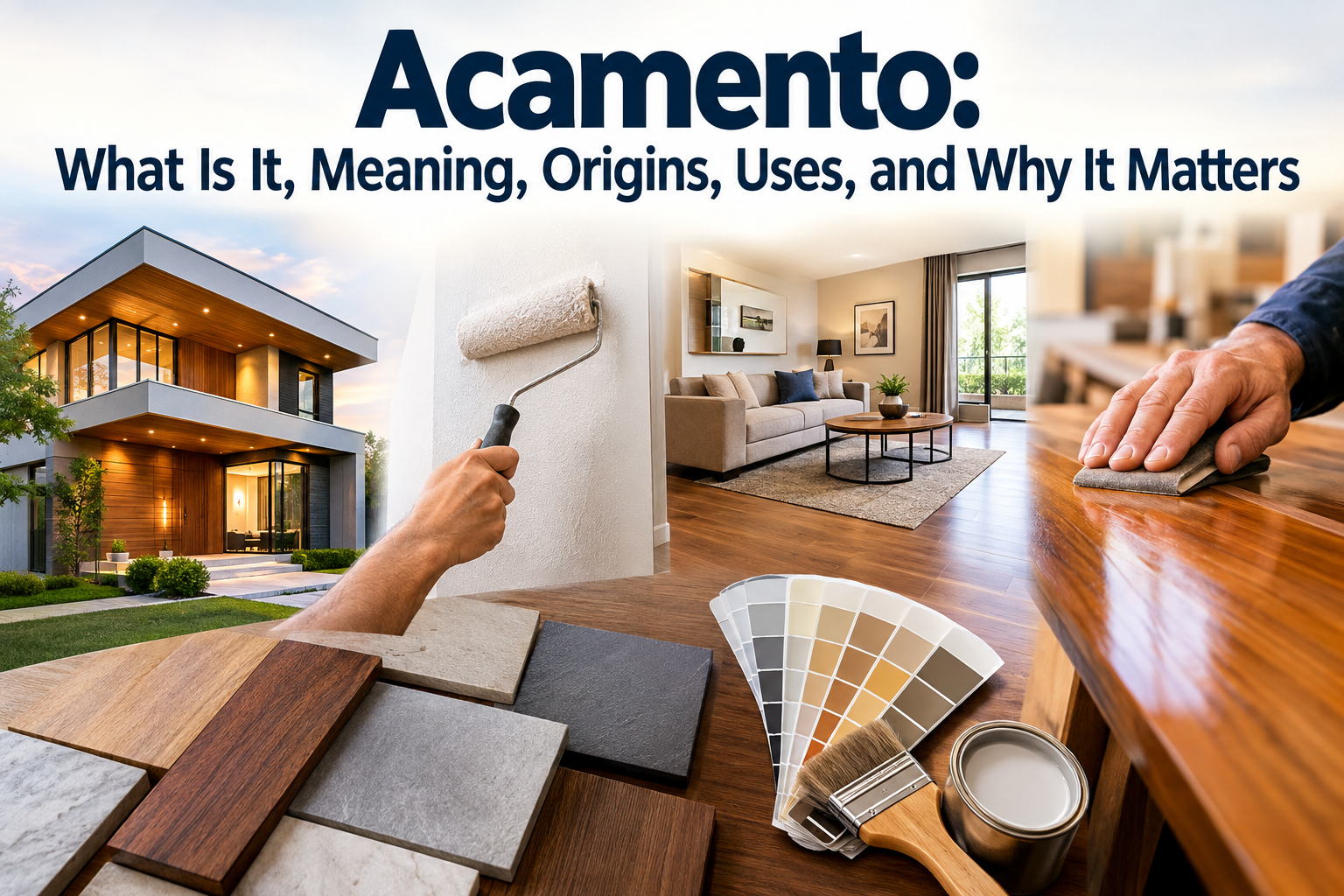
The importance of Acamento becomes clearer when we consider everyday examples. A newly constructed house may have its basic structure completed, but it does not feel finished until the walls are painted, floors are installed, surfaces are treated, and small details are completed. Similarly, a piece of furniture may be functional after it is assembled, but sanding, polishing, staining, or coating can give it a much more attractive and durable final appearance. In this sense, Acamento represents the stage where quality, appearance, protection, and functionality come together.
What Does Acamento Mean?
At its simplest, Acamento can be understood as finishing or refinement. It describes the process of giving something its final treatment so that it looks better, performs properly, and feels complete. The idea can apply to physical objects, buildings, furniture, interiors, products, and even creative or digital work.
The term is often connected with acabamento, a Portuguese word associated with finishing and final touches. In construction and design, finishing can include painting, polishing, coating, tiling, sanding, texturing, and other processes that improve the final condition of a surface. These processes may appear simple, but they can have a significant effect on the overall quality of a finished product.
Acamento can therefore be viewed as more than decoration. A finish can protect a material from moisture, scratches, sunlight, stains, or general wear. It can also make an object easier to clean and more comfortable to use. For this reason, the concept combines aesthetic improvement with practical function.
Is Acamento a Person or a Concept?
One important point to clarify is that Acamento is generally discussed as a term or concept rather than a specific person. There is no reliable basis for presenting Acamento as a famous man or woman with a conventional biography. Online articles may sometimes give unusual words elaborate identities or meanings, but readers should be careful about accepting such claims without evidence.
When people search for Acamento, they are generally looking for an explanation of the term, its meaning, or its connection to finishing and refinement. Treating it as a concept provides a much more useful and accurate way to understand the word.
The concept can be summarized through a simple idea: something may be technically complete without being truly finished. The final details are often what transform an ordinary result into a polished one.
The Connection Between Acamento and Acabamento
The strongest linguistic connection associated with Acamento is the Portuguese word acabamento. Acabamento is commonly related to finishing, completion, or the final treatment of something. It is particularly relevant in areas such as construction, architecture, furniture, manufacturing, and interior design.
The shortened form “Acamento” can appear because of spelling variations, informal usage, translation differences, or online content. Since internet language changes quickly, unusual spellings can become searchable terms even when another form is more established in the original language.
This distinction is useful for readers because it prevents confusion. Someone searching for Acamento may actually be trying to understand acabamento or a concept derived from it. In practical terms, both point toward the broader idea of finishing, refinement, and completion.
Acamento in Construction
Construction is one of the clearest areas in which the idea of Acamento can be understood. A building begins with structural elements such as foundations, walls, columns, roofing, and other essential components. However, a structure is not normally considered ready for occupation simply because its basic framework is complete.
The finishing stage gives the building its final appearance and usability. This can include painting, flooring, tiling, plastering, ceiling work, doors, windows, fixtures, wall treatments, and surface coatings. These details may seem secondary compared with structural work, but they strongly influence the comfort and appearance of the finished building.
Good finishing can also improve durability. For example, a protective coating may help a surface resist moisture, while an appropriate flooring finish can make a floor easier to maintain. Exterior finishes can help surfaces deal with weather exposure and everyday environmental conditions.
This demonstrates why Acamento should not be viewed simply as decoration. The final treatment can affect both how something looks and how long it remains useful.
Acamento in Interior Design
Interior design provides another excellent example of the Acamento concept. An interior may contain high-quality furniture and carefully planned spaces, but the final details often determine whether the room feels truly complete.
Wall textures, paint finishes, flooring, cabinetry, lighting details, hardware, decorative surfaces, and fabric treatments can all contribute to the final character of an interior. A designer may select a matte finish for a calm appearance, a glossy surface for a more contemporary feeling, or a textured treatment to add visual depth.
These choices are not only aesthetic. The correct finish can influence cleaning, maintenance, durability, light reflection, and everyday comfort. A kitchen surface, for example, needs to look attractive but should also be practical and easy to maintain.
Acamento therefore fits naturally into interior design because it represents the final layer of thought and craftsmanship that brings a space together.
Acamento in Furniture and Craftsmanship
Furniture makers have always understood the importance of finishing. A wooden table can be structurally strong, but rough edges, uneven surfaces, or an untreated top can make it feel incomplete. Sanding, staining, varnishing, polishing, and protective coating can dramatically change the final result.
The same principle applies to handmade products. Skilled craftsmen often spend considerable time on details that customers may notice without consciously understanding why the product feels high quality. Smooth edges, consistent textures, carefully treated surfaces, and clean joints all contribute to a sense of craftsmanship.
This is one reason the idea of Acamento is closely connected with attention to detail. The final stage can require patience because small imperfections become much more visible when a product is almost complete.
Why Finishing Matters So Much
The importance of Acamento comes from the fact that people naturally judge quality through what they can see and feel. A well-finished object often appears more valuable, even when its basic structure is similar to a less carefully finished alternative.
Finishing can provide several benefits:
- Improved appearance
- Greater surface protection
- Better durability
- Easier maintenance
- Improved comfort
- Higher perceived quality
- A stronger sense of completion
For businesses, finishing can also influence customer satisfaction. Consumers often associate clean design and careful finishing with professionalism. In architecture and manufacturing, the final appearance can affect how a product or property is perceived.
In other words, Acamento is important because the final details can have an impact much greater than their size suggests.
Acamento as an Idea of Refinement
Beyond physical surfaces, Acamento can also be understood as a broader idea of refinement. The same principle applies to writing, digital products, creative projects, and professional work.
Consider an article that has already been written. The main work may be complete, but proofreading, improving headings, correcting grammar, checking facts, and removing unnecessary repetition can make the final article much stronger. Similarly, a website may technically function but still need better navigation, mobile optimization, clearer buttons, and improved visual organization.
This broader interpretation captures an important lesson: being finished and being polished are not always the same thing.
Acamento represents that final effort that turns something acceptable into something more carefully prepared. It encourages people to look at the details rather than stopping as soon as the main task is complete.
Common Misunderstandings About Acamento
One of the biggest misunderstandings about Acamento is assuming that it has one universally recognized meaning. Online content sometimes presents the term as a specific technology, platform, philosophy, or brand without enough evidence to establish those claims.
A more cautious interpretation is preferable. The strongest and most understandable association is with finishing, completion, and refinement, particularly through its relationship with the Portuguese word acabamento.
Another misunderstanding is that finishing only concerns appearance. In reality, finishing can influence protection, maintenance, durability, comfort, and performance. A surface treatment may look attractive while also protecting the underlying material.
Therefore, Acamento should be understood as a concept with both visual and functional importance.
The Future Relevance of Acamento
As design and manufacturing continue to evolve, finishing techniques are becoming increasingly sophisticated. Modern materials can offer unusual textures, improved durability, easier maintenance, and environmentally conscious properties. Digital manufacturing and advanced production techniques are also allowing designers to create increasingly detailed surfaces.
At the same time, consumers are becoming more attentive to product quality and design. People do not simply want objects that work; they often want products that feel carefully made and visually appealing.
This makes the central idea behind Acamento increasingly relevant. Whether the term itself becomes widely standardized or remains a niche expression, the principle of careful finishing and thoughtful refinement will continue to matter.
Conclusion
Acamento is best understood as a term associated with finishing, completion, refinement, and final attention to detail. Its strongest linguistic connection is with the Portuguese word acabamento, which relates to finishing and the final treatment of something. Although Acamento is not generally a person or a conventional name, it has become an interesting search term because it can be interpreted across construction, design, craftsmanship, manufacturing, and modern creative work.
The importance of Acamento goes far beyond making something look attractive. A carefully selected finish can improve durability, protection, maintenance, comfort, and overall user experience. In construction, finishing makes a building feel complete. In furniture making, it can transform raw material into a polished product. In interior design, it helps create a cohesive environment. In writing and digital work, the same philosophy can be applied through proofreading, testing, correction, and final refinement.
Ultimately, the central message of Acamento is simple: completion is not always the same as perfection, and the final details often determine the quality of the finished result. Whether applied to a physical surface or a creative project, thoughtful finishing remains one of the most important ways to turn ordinary work into something polished, useful, and memorable.
FAQs About Acamento
1. What is Acamento?
Acamento is generally associated with finishing, completion, and refinement. It is often connected with the Portuguese word acabamento and can describe the final treatment that makes an object, surface, building, or project feel complete.
2. Is Acamento a person?
No. Acamento is generally discussed as a term or concept, not as a specific man or woman. There is no reliable basis for treating it as a conventional celebrity or public figure.
3. What is the connection between Acamento and acabamento?
Acamento is commonly associated with the Portuguese word acabamento, which refers to finishing or final touches. The two terms are therefore closely related in discussions about surfaces, construction, design, and craftsmanship.
4. Where is the idea of Acamento used?
The concept can be applied to construction, architecture, interior design, furniture, manufacturing, craftsmanship, and creative work. It generally describes the final stage of improving, protecting, or refining something.
5. Why is Acamento important?
Acamento is important because finishing can improve more than appearance. A good finish can provide protection, durability, easier maintenance, comfort, and a stronger sense of quality, helping transform an unfinished result into a polished final product.